What the frequency does to a motor
Run on the other system, the motor is no longer running at the supply it was designed for — its nameplate states a rated frequency beside its rated voltage, and the mismatch is against that printed pair.
What does not work
A converter drive's output frequency is a setting, so the motor can be supplied at its nameplate frequency, where the model's published input and output ratings cover the supply and the motor.
How a converter drive solves it
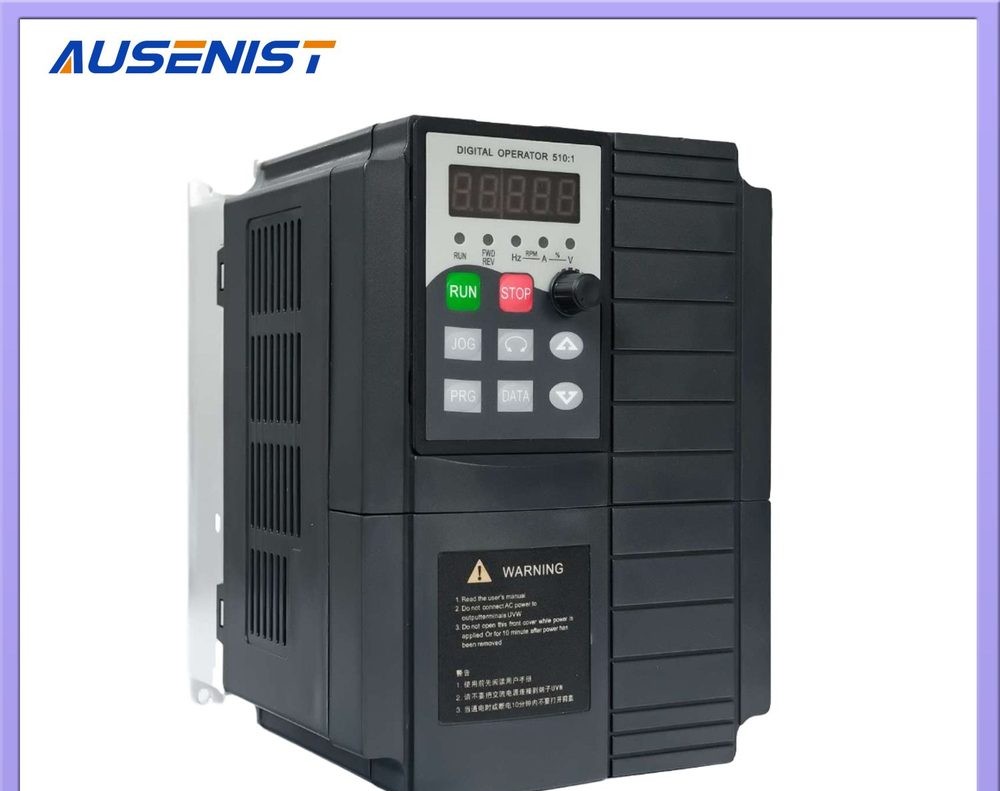
That is why the conversion models in this catalogue are specified the way they are: the AU400's documentation publishes a 50/60 Hz input with output frequency to 500 Hz under V/F control — the output frequency is a setting, not a consequence. The platform catalogue likewise lists a 0.75–5.5 kW, 220 V-to-380 V converter line specifically for 50 Hz/60 Hz conversion duty, — see the frequency converters page.
The input side of a mainstream drive is frequency-tolerant by specification — the EV510, for example, publishes an input frequency range of 47–63 Hz.
That input tolerance is printed, not assumed: the main series publish 50/60 Hz input classes, the AU400 documents its 220 V ±15% input at 50/60 Hz, and the EV510's published input frequency range runs wider still, at 47–63 Hz.
The two conversion jobs, separated
Job one is pure frequency: the voltage class is right, the frequency is wrong. Job two is frequency plus voltage class: imported machinery expecting 380 V 60 Hz on a 220 V 50 Hz site, for example — the boost conversion territory of the AU400 (220 V single-phase in, 380 V three-phase out, 1.5–75 kW), whose settable output frequency covers the frequency side of the problem in the same box. Separating the two jobs in your enquiry — “the motor is 380 V, 60 Hz, 7.5 kW; the site is 220 V single-phase, 50 Hz” — and ask for the model against those figures to be stated in the quotation.
Settings that matter after conversion
For the settings side, a conversion enquiry states three things: the motor's rated frequency and voltage (the nameplate values — 60 Hz, not the grid's 50), the maximum frequency limit for the duty (set for the duty) and the acceleration ramps the machine needs (a converted machine's inertia has not changed, but its controller is new).
Scope note
Everything here concerns motor loads. Static frequency converters for electronic equipment, laboratories or 400 Hz aircraft power are a different product class and are not part of this catalogue — the converters page states the same boundary.
Worked examples
Two examples fix the direction of the mismatch. A 60 Hz pump installed on a 50 Hz grid without conversion is no longer running at the supply its nameplate specifies. In the mirror case, a 50 Hz fan on a 60 Hz supply is in the same position. A converter drive's output frequency is a setting: set to the nameplate frequency, it supplies the motor at that frequency, where the model's published ratings cover the installation.
The nameplate figures
The motor's nameplate states rated frequency beside rated voltage — often as a dual rating (for example 50/60 Hz machines with two nameplate lines, in which case the nameplate itself prints both frequencies, and its voltage lines can be checked against the site supply as well). Where the nameplate is single-frequency, the enquiry states four numbers: motor voltage, motor frequency, motor power or current, and the site's voltage, phases and frequency.
What the pump and solar lines print
The conversion question also appears in the pump material. The AU820 pump documentation publishes input voltage classes of 220 V AC ±15% and 380 V ±15% with an input frequency range of 50/60 Hz and a fluctuation allowance of ±5%, and the YSG solar documentation publishes its output frequency as 50/60 Hz with a programmable adjustment range of 15–60 Hz. A conversion enquiry states the site's frequency beside its voltage.
Input classes printed for the conversion models
The AU720 documentation, for the general range, publishes its input classes as 380 V ±15% (323–437 V) and 220 V ±15% (187–253 V) at 50/60 Hz; the EV510 publishes an input frequency range of 47–63 Hz. The AU400's published overload classes are G mode 150% for 60 s and 180% for 3 s, and P mode 120% for 60 s and 150% for 3 s. Those printed input figures are the site side of a conversion enquiry; the motor side is the nameplate frequency and voltage stated above.
Frequently asked questions
Can I just run my 60 Hz motor on 50 Hz if I lower the voltage?
Voltage is not the mismatch: the motor's nameplate states a rated frequency beside its rated voltage, and a 50 Hz grid does not supply a 60 Hz nameplate frequency. A converter drive's output frequency is a setting, so it can be set to the nameplate frequency where the model's published ratings cover the installation.
Does the drive itself care about 50 vs 60 Hz input?
The published input specifications accept 50/60 Hz — the AU400 documents 220 V ±15% at 50/60 Hz, and the main series publish 50/60 Hz input classes. The output frequency is set independently of the input frequency.
Send us your motor rating and application
Tell us the motor power, the supply voltage on site and what the drive will run — pump, fan, machine tool or lift. Minimum order is 1 piece on the main catalogue lines, as published on the platform store; ask for price and lead time for your model and quantity to be stated in the quotation. Email [email protected] or message us on WhatsApp.