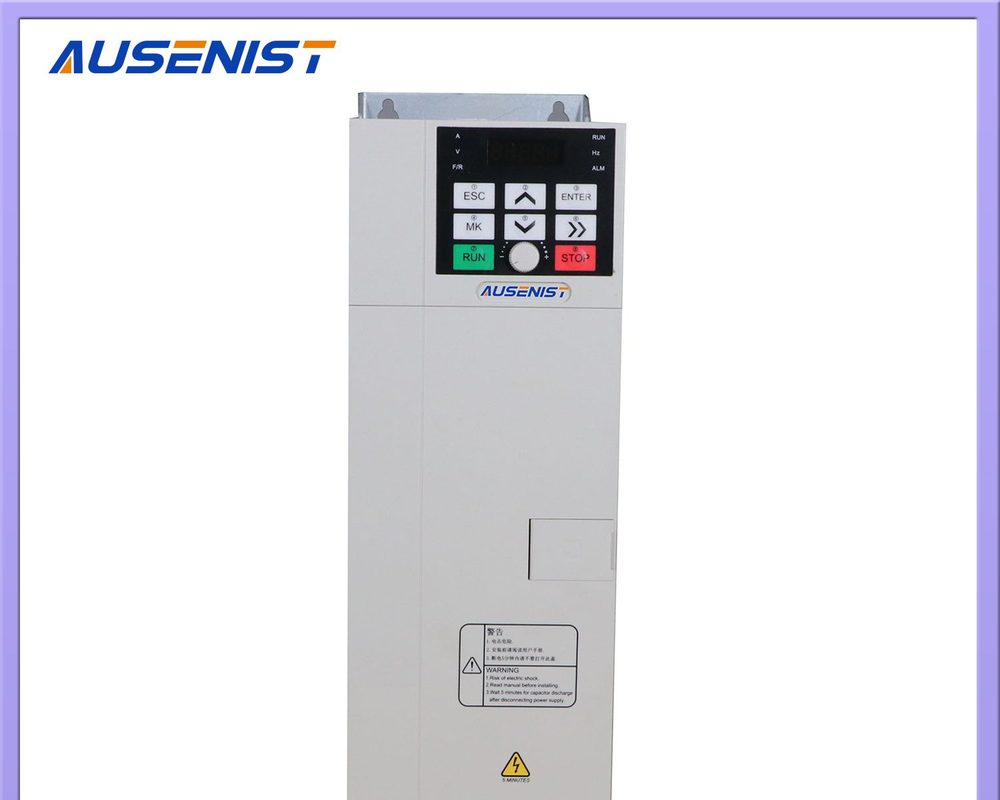
Documented elevator functions
- Four independent S-ramp profiles and programmable DC-injection braking.
- Integrated brake control and mechanical torque-limitation protection, with high starting torque — 180% at 0 Hz (G type) in closed-loop vector mode — for loaded starts.
- Slip compensation and automatic torque boost, flexible programmable I/O, simplified parameters for a fast start-up and comprehensive trip diagnostics.
- Motor overheating protection and prompt current limiting; an in-built dynamic braking unit is standard in the published feature set.
Published specifications — AU1000
| Control modes | Sensorless flux vector (SFVC), closed-loop vector (CLVC), V/F control |
| Maximum frequency | Vector control 0–300 Hz; V/F control 0–320 Hz (AU1000) |
| Carrier frequency | 0.5–16 kHz, auto-adjusted with load |
| Starting torque | G type: 0.5 Hz/150% (SFVC), 0 Hz/180% (CLVC); P type: 0.5 Hz/100% (AU1000) |
| Speed range / stability | 1:100 (SVC), 1:1000 (FVC); ±0.5% (SVC), ±0.02% (FVC); torque control accuracy ±5% (FVC) (AU1000) |
| Overload capacity | G type: 150% of rated current for 60 s, 180% for 3 s; P type: 120% for 60 s, 150% for 3 s (AU1000) |
| Communications | Modbus-RTU, PROFIBUS-DP, CANlink and CANopen documented |
| Encoders | Differential, open-collector, resolver, UVW and SIN/COS encoder types supported via the documented options |
| Individualised functions | Power-dip ride-through, rapid current limit, five groups of virtual I/O, timing control (0.0–6500.0 min), four-motor switchover parameter sets (AU1000) |
The company's catalogue also lists the L1000A elevator inverter series and elevator VFD models for passenger lift motors; for ratings for those models, ask with your enquiry. When you enquire, send the lift's motor rating, whether the installation is geared or gearless, and whether the controller expects integrated brake control and a particular fieldbus — and ask for the drive to be matched to the lift system, not just the motor, in the quotation.
Individualised functions published for the AU1000
The AU1000 documentation lists individualised functions including: high-performance current-vector control of asynchronous and synchronous motors; power-dip ride-through; rapid current limiting; five groups of virtual I/O; timing control over a 0.0–6500.0 minute range; four motor parameter sets with switchover; multiple communication protocols; motor overheat protection; and multiple encoder types. The headline specification also lists four independent S-ramps and programmable DC-injection braking, and the standard-function list includes slip compensation.
The same specification publishes further standard functions for the series: an onboard PID function, described as realising a process-controlled closed-loop system; V/F separation in complete and half forms; N-power V/F curves (1.2, 1.4, 1.6 and 1.8 power, and square); DC braking with an action time of 0.0–36.0 s; and jog control over a 0.00–50.00 Hz frequency range with its own acceleration and deceleration time.
Frequently asked questions
Is the AU1000 suitable for modernisation projects?
Its documented functions include programmable I/O, multiple fieldbus protocols, several encoder types and slip compensation. Send the existing motor and controller details with your enquiry and ask for compatibility to be addressed in the quotation.
What starting torque is available for a loaded car?
180% at 0 Hz in closed-loop vector (CLVC) mode for the AU1000's G-type models, per the published specification; the G type also publishes 150% at 0.5 Hz in sensorless (SFVC) mode.
Which encoders are supported?
Differential, open-collector, resolver, UVW and SIN/COS encoders are listed in the AU1000 documentation, via the corresponding PG options.
Send us your motor rating and application
Tell us the motor power, the supply voltage on site and what the drive will run — pump, fan, machine tool or lift. Minimum order is 1 piece on the main catalogue lines, as published on the platform store; ask for price and lead time for your model and quantity to be stated in the quotation. Email [email protected] or message us on WhatsApp.