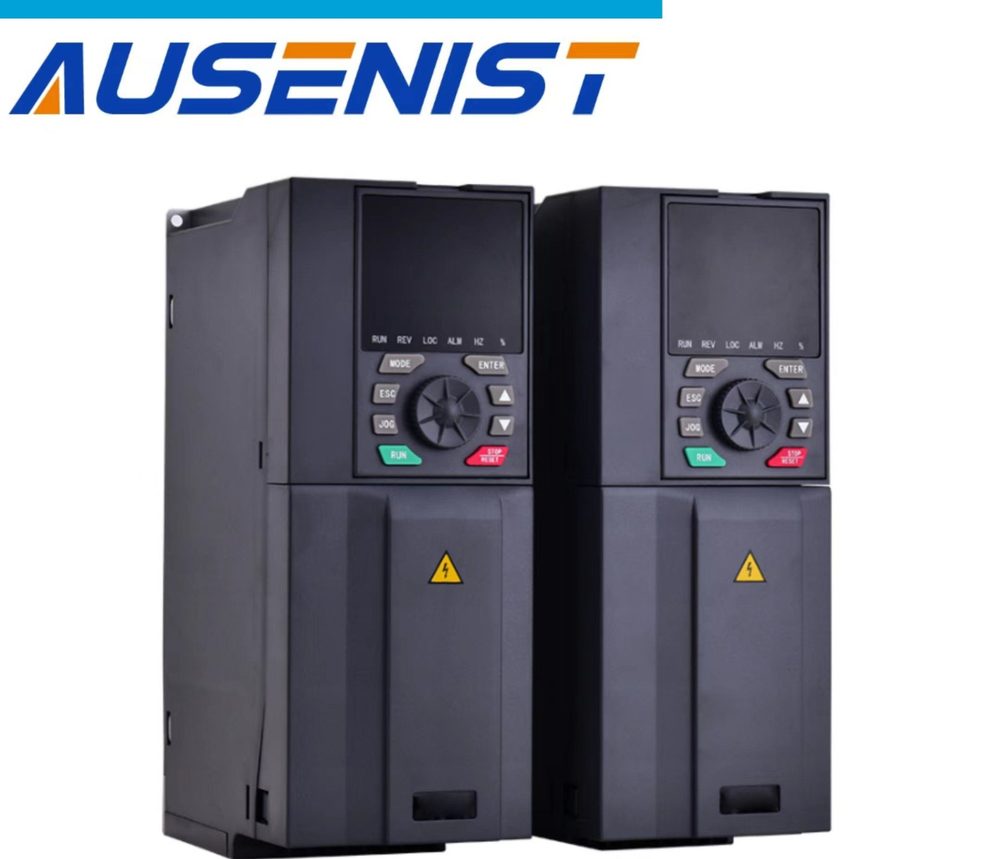
What each device actually does
A soft starter controls the voltage applied to the motor during starting and stopping. In the AU6800's documentation, adaptive control reads the motor's data during starting and stopping and adjusts the acceleration and deceleration curves accordingly. A VFD controls the voltage and frequency supplied to the motor; how the two are paired depends on the control mode — the AU1000's documentation, for example, publishes complete and half V/F separation.
| Question | Soft starter (AU6800) vs VFD |
|---|---|
| Starting | Soft starter: adaptive acceleration/deceleration curve control, a series of starting methods and quick settings documented (AU6800). VFD: programmed ramps and S-curves; starting torque to 150% at 0.25 Hz (AU720 SVC, documented) |
| Running speed | Soft starter: no running-speed control is documented — its documented role is start/stop control and protection. VFD: continuously variable across the published frequency range |
| Energy saving | Soft starter: no saving figure is published for the AU6800 — its documented role is the start and the stop. VFD: no general figure is published; a series' own documented claim (such as the AUD32 fan mode) is stated with its scope on its page |
| Stopping | Soft starter: adaptive deceleration (soft stop) documented. VFD: ramp or DC-injection braking, plus dynamic braking options per series |
| Protection & data | Soft starter: AU6800 documents a full motor-protection set, performance monitoring and an event log. VFD: series-level protection sets plus process PID and fieldbus options |
| Documented role | Soft starter: controlled starting and stopping, with a protection set. VFD: continuous speed control across the published frequency range, with controlled starting and stopping |
The soft starter's documented role
The soft starter's documented role covers the start and the stop of a motor: starting current and mechanical shock are among the problems its documented functions address. The AU6800 covers 55–400 kW. See the soft starters page.
AU6800 details that matter at specification time
The AU6800 documentation publishes a large LCD displaying in Chinese and English — other languages customisable — with the operation panel able to be installed remotely by lengthening its connection. It publishes a series of starting methods and a quick-settings route documented as providing correct parameters for most applications. Its event log and performance monitoring are published alongside the protection set in the same documentation, and its incoming-cable options (top, bottom and left) are published as well.
The VFD's documented role
A VFD controls speed continuously. Which device a given process needs is an enquiry item: state whether the duty varies — airflow or water demand changing through the day, different speeds for different products, torque or position held at low speed — and ask for the documented options for it to be stated in the quotation.
Frequently asked questions
Can a soft starter save energy like a VFD?
No figure of that kind is published: the AU6800's documentation publishes no energy-saving figure, and its documented role is the start and the stop.
Is a VFD always the better choice?
The two types document different roles: the AU6800 documents controlled starting and stopping, with a protection set; a VFD documents continuous speed control across the published frequency range, with controlled starting and stopping. State the motor and the duty in your enquiry and ask for the documented figures for each type to be stated in the quotation.
Can I start with a soft starter now and add a VFD later?
They are alternative devices on the same motor, not stages of one system. If speed control is foreseeable, raise it in the first enquiry and ask for both options to be addressed against the same duty.
Send us your motor rating and application
Tell us the motor power, the supply voltage on site and what the drive will run — pump, fan, machine tool or lift. Minimum order is 1 piece on the main catalogue lines, as published on the platform store; ask for price and lead time for your model and quantity to be stated in the quotation. Email [email protected] or message us on WhatsApp.