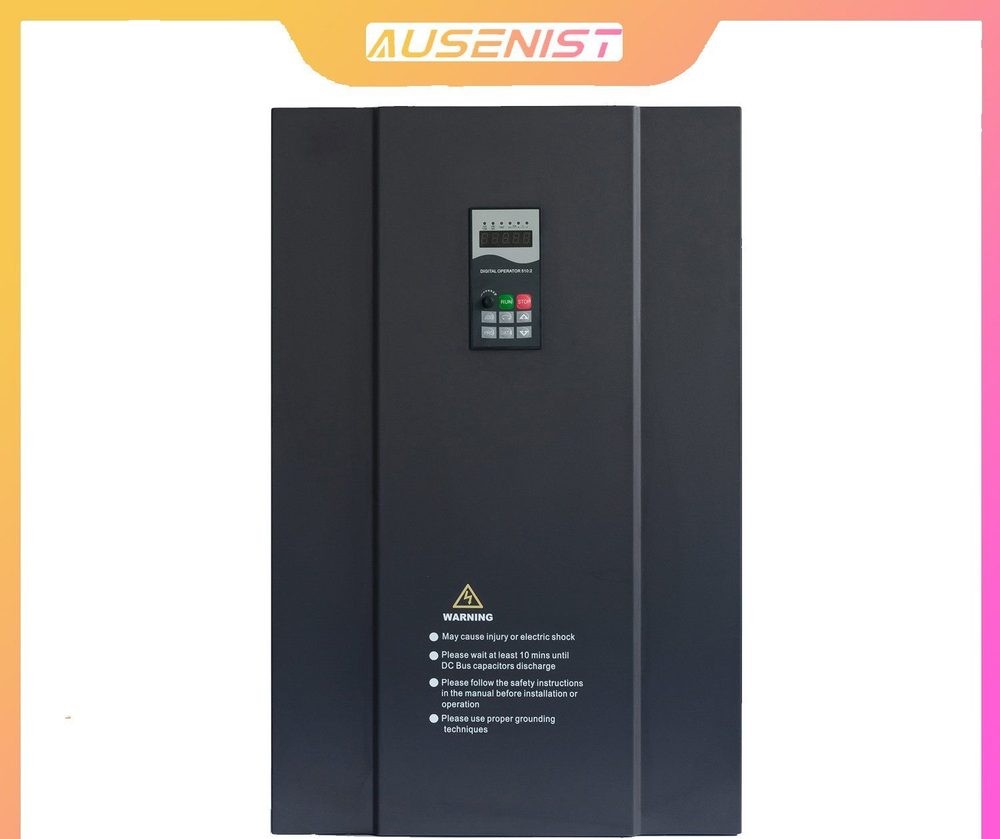
The documented textile routes
AUD32 — the slim drive. The AUD32 documentation names textile among its industries and publishes a slim book format with LCD; its documented functions include anti-jitter ride-through through short power dips and up to 16 speed settings. The general small-machine line is the AU320, whose published table is on the AU320 page.
Wobble frequency control. The AU400's documentation lists wobble frequency control — multiple triangular-wave frequency control, special for textile — among its control functions, with timing, length and counting control alongside.
EV200 — the compact format. The EV200's application list includes textiles, and its documented construction comprises an independent air-duct design, side-by-side mounting, and an installation size reduced by 30% against the older products. The EV200 documentation also states the braking arrangement — braking units built in above 3.7 kW, not built in at 0.75–2.2 kW — which matters on machines with frequent stops. Its model table runs 0.4–5.5 kW across single-phase 220 V and three-phase 380 V inputs. The EV200's published model table is summarised on the mini-VFD page.
Textile references in the series documentation
| Series | Published textile reference |
|---|---|
| AUD32 | Textile among its documented industries; up to 16 speed settings, slim format |
| AU400 | Wobble frequency control — multiple triangular-wave frequency control, special for textile — with timing, length and counting control |
| AU8000 | Its application list includes printing and dyeing plants; sealed format — see the waterproof page |
| EV200 | Textiles in its documented application list; compact format |
Multi-machine lines and common spares
For multi-machine plants, the published terms are these: the 1-piece minimum order is published for the main listed lines on the platform store; documented function lists are published per series; and the AUD32 and EV200 are documented compact formats — the EV200 with an installation size reduced by 30% against the older products. OEM machine builders get the documented customisation options on the OEM page.
Process notes from the documentation
Two documented behaviours map directly onto textile pain points. The AUD32's anti-voltage-jitter function, keeping the drive running at low frequency through instantaneous power failures of up to 2.35 seconds, addresses the grid blinks that otherwise stop machines mid-cycle. And the AUD32's documented function set includes up to 16 speed settings and an LCD dialogue. Both behaviours are stated in the series' published function set.
Specification habit worth adopting plant-wide: when a textile machine is quoted, ask for the drive's documented function list by name — anti-jitter ride-through, multi-step speed, wobble frequency, built-in PID — rather than accepting “suitable for textiles”. The series on this page publish those lists; a claim that cannot be pointed to in a function list is a claim to price accordingly.
Frequently asked questions
Can the drive keep a machine running through power dips?
The AUD32 documentation describes an anti-voltage-jitter function keeping the drive running at low frequency through instantaneous power failures of up to 2.35 seconds. The EV510 documents an instantaneous-stop ride-through as well.
Do you serve textile OEMs?
OEM supply is the company's published business model; the documented customisation options are on the OEM page.
Send us your motor rating and application
Tell us the motor power, the supply voltage on site and what the drive will run — pump, fan, machine tool or lift. Minimum order is 1 piece on the main catalogue lines, as published on the platform store; ask for price and lead time for your model and quantity to be stated in the quotation. Email [email protected] or message us on WhatsApp.