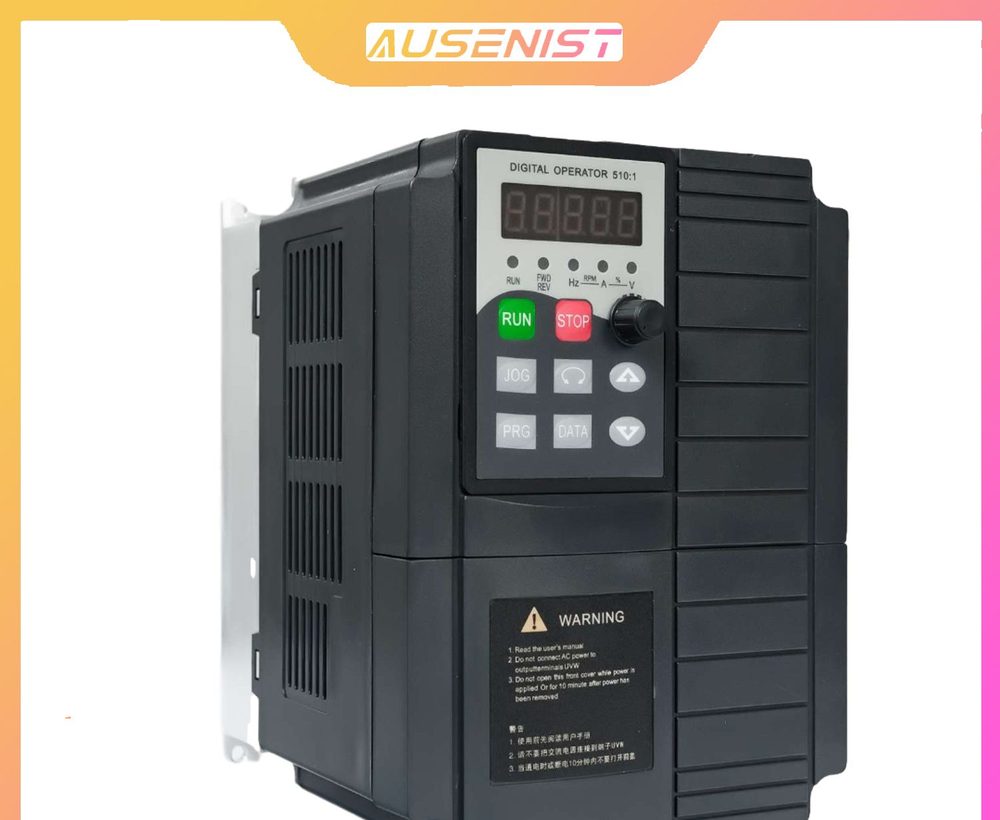
Two different conversion jobs
Voltage-class conversion. The AU400 series was developed, in its own documentation's words, for occasions where three-phase power is lacking: it takes a 220 V single-phase input and delivers a 380 V three-phase output across a published 1.5–75 kW range, with current vector control, so standard 380 V motors can run on sites that only have a single-phase service. The AU400 ratings are on the dedicated AU400 boost inverters page.
Frequency-system conversion. Equipment built for a 60 Hz system and equipment built for a 50 Hz system carry different nameplate frequencies. The company's catalogue lists 50 Hz/60 Hz conversion drives — for example a published 0.75–5.5 kW converter line for 220 V to 380 V conversion across 50/60 Hz systems, and AU400-class models whose documentation covers 50/60 Hz input with output frequency to 500 Hz under V/F control. A conversion enquiry states the motor's nameplate frequency and the local grid, and asks for the model against them to be stated in the quotation.
Motor drives, not static converters
Choosing a conversion drive
- State the input you actually have: voltage, phases and frequency (for example 220 V single-phase 50 Hz).
- State the motor: its rated voltage, frequency and power — the nameplate is the specification.
- For boost conversion (220 V in, 380 V out), the AU400's published overload classes are G mode 150% for 60 s / 180% for 3 s and P mode 120% for 60 s / 150% for 3 s; the braking unit is built in from 1.5–22 kW, optional at 30–37 kW and external above 37 kW.
- For 50/60 Hz conversion, state whether the motor must run at its nameplate frequency continuously or only needs soft starting at the converted frequency.
Single-phase input models more broadly — including the compact AU320 single-phase-input models — are covered on the single-phase VFD page, and the background to how conversion interacts with motor nameplates is in the blog guide to 50 Hz / 60 Hz frequency conversion.
Frequently asked questions
Can I run a 380 V motor on a 220 V single-phase supply?
Yes, with a boost inverter: the AU400 takes 220 V input and delivers 380 V three-phase output across 1.5–75 kW. The motor is connected in its standard three-phase configuration; the drive does the conversion.
Will a converter drive let a 60 Hz motor run at 60 Hz on 50 Hz mains?
Yes, on the frequency point: output frequency is a setting on the drive, independent of the input frequency — a 60 Hz motor can be supplied at 60 Hz from a 50 Hz grid, within the drive's published ratings.
Is a frequency converter the same as a VFD?
In the motor-drive sense used here, yes: the same product family. The term “frequency converter” on this page always means a VFD-type converter for motor loads, not a static power-supply converter.
Send us your motor rating and application
Tell us the motor power, the supply voltage on site and what the drive will run — pump, fan, machine tool or lift. Minimum order is 1 piece on the main catalogue lines, as published on the platform store; ask for price and lead time for your model and quantity to be stated in the quotation. Email [email protected] or message us on WhatsApp.