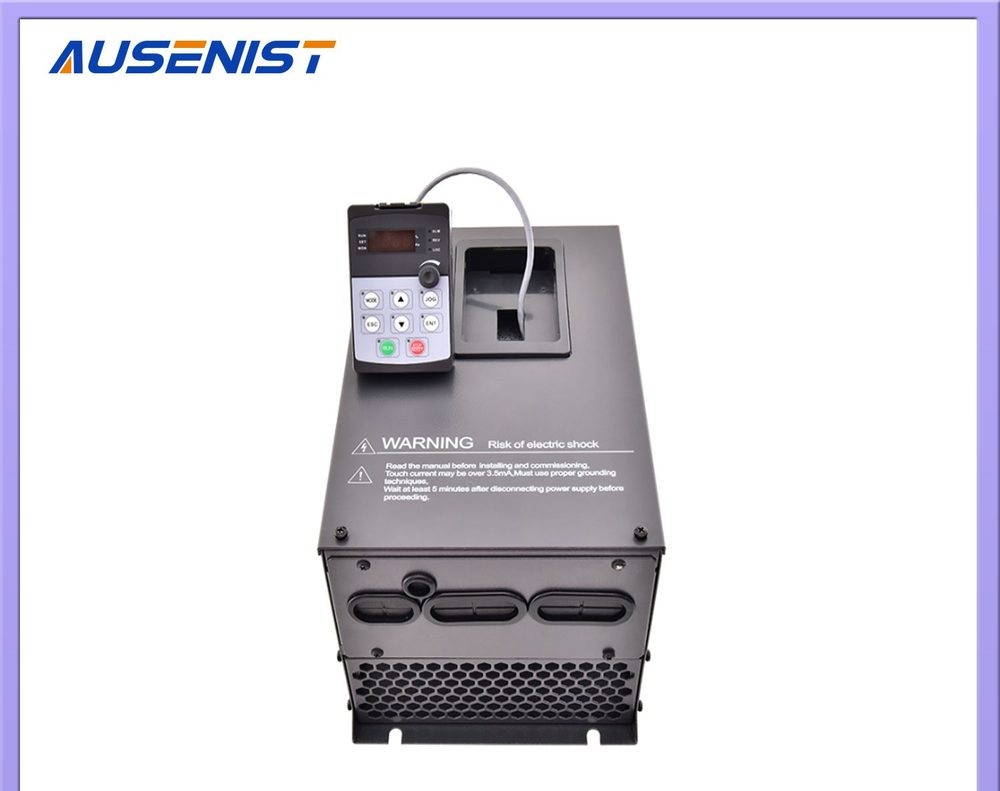
What a VFD does, in one paragraph
A drive's output frequency is a setting rather than a fixed inheritance from the grid. The series documentation names controlled starting, controlled stopping and a protection set among the drive's documented functions.
Why not just run the motor direct-on-line?
A direct-on-line starter connects the motor straight to the mains, and the motor runs at its mains-determined speed. A drive replaces that pattern with a programmed start ramp and a settable speed, and its documented protection set — overcurrent, overload, overvoltage, phase loss, short circuit — watches the motor while it runs.
The input question: three-phase, single-phase, or boost
The motor is three-phase in all cases; what varies is what the site can supply. Where a three-phase service exists, the mainstream model tables apply — the AU720 runs 0.75–500 kW on a 380 V class supply (220 V class also published), and the EV510's classes reach from 220 V to 1140 V. Where only a single-phase 220 V service exists, two published routes cover it. The first is a single-phase-input drive: the AU320 publishes dedicated S1 models from 0.75 to 5.5 kW that take single-phase 200–240 V in and deliver three-phase 0–240 V out. The second, for standard 380 V motors, is a boost inverter: the AU400 takes 220 V single-phase in and delivers 380 V three-phase out across 1.5–75 kW, so the motor keeps its normal configuration. The one thing to keep straight is that “single-phase” in these model names describes the input. The output is three-phase, and the drives are specified for three-phase motors.
Control modes: how hard the drive thinks
Three levels of control appear across the range, and the differences are published numbers, not adjectives. V/F control is the first of the three methods the series documentation names. Sensorless vector control (SVC) works without an encoder; on the AU720 it publishes 150% starting torque at 0.25 Hz, a 1:200 speed range and ±0.5% steady-speed precision. Closed-loop vector control (FVC) adds an encoder; the AU720, and the EV510 for its G type, publish FVC figures of 180% starting torque at 0 Hz, a 1:1000 range and ±0.02% precision. The motor control guide covers the three in detail.
Sizing: the published current figures
The published model tables print current beside power where the table carries a current column: an AU320-2.2S1, for example, is a 2.2 kW model with a 9 A output rating — if your 2.2 kW motor's nameplate says 10 A, that model's published current does not cover it. The published overload-class pair on the AU1000/EV510-pattern specification is the heavier G class (150% of rated current for 60 s, 180% for 3 s) and the lighter P class (120% for 60 s, 150% for 3 s). Which class a given duty takes is not printed in the tables — state the motor and duty in your enquiry and ask for the class and the applicable model against the nameplate to be stated in the quotation. See the sizing guide for the published figures for the same check.
Commissioning basics
The series documentation names the elements commissioning works with. The AUD32 documents motor parameter identification — its documentation describes advanced motor parameter identification and flux estimation among its functions. Control sources are documented per series: keypad, terminals, or serial communication (RS485 Modbus is built into the AU321 and AU720). Ramp settings and protection parameters are documented setting groups in the series material.
The short answer
The enquiry states four things: the input class your site can feed, the motor's nameplate current, the control mode the duty is specified with, and a request for the model, price and lead time to be stated in a quotation. The product index maps the series; the contact page starts the conversation — a motor nameplate photo carries most of those figures in one image.
Wiring and protection basics
The physical installation is standard electrical work with three drive-specific disciplines. The motor connects to the drive's output terminals, and any contactor arrangement around the drive is an installation-design question to state in the enquiry rather than improvise; the drive's input takes the site's protective devices as any industrial load does. Motor cable length is an installation figure: state the run between drive and motor in the enquiry for well and machine installations, and ask for the configuration for it to be covered in the quotation. Earthing follows the manual for the series.
Three mistakes to avoid
First, sizing by kilowatts alone and discovering the motor's current exceeds the drive's rating — the published tables print current beside power where the table carries a current column, so the nameplate current can be checked against them. Second, buying a single-phase-input drive for a single-phase motor — “single-phase” in these model names describes the input, and the drives are specified for three-phase motors — see the single-phase page. Third, leaving the drive on factory parameters and judging it by the result — motor data entry and ramp settings are documented setting groups in the series documentation.
Frequently asked questions
Will a VFD damage an older motor?
Ask about the motor's suitability for low-speed duty with the enquiry, and send the motor data with it.
Can one VFD run several motors?
The published documentation for these series does not state a multi-motor arrangement. Describe the arrangement in the enquiry and ask what can be offered for it.
Send us your motor rating and application
Tell us the motor power, the supply voltage on site and what the drive will run — pump, fan, machine tool or lift. Minimum order is 1 piece on the main catalogue lines, as published on the platform store; ask for price and lead time for your model and quantity to be stated in the quotation. Email [email protected] or message us on WhatsApp.