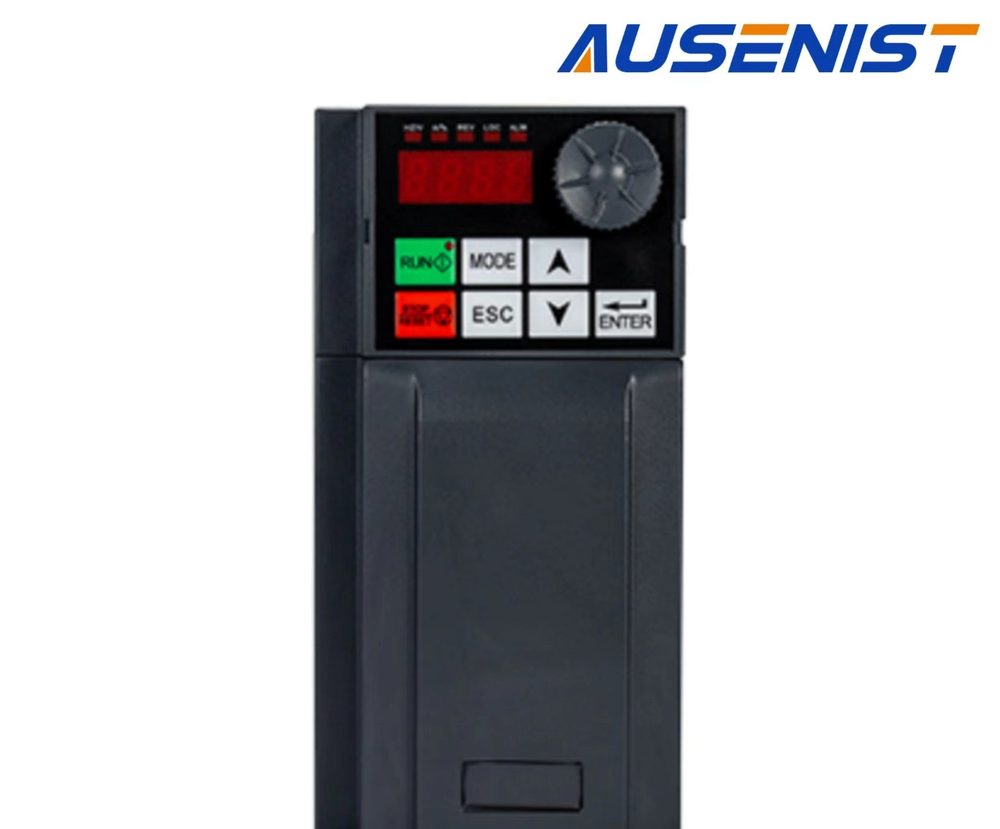
The published reference band, with its scope stated
The company's platform store publishes an FOB price band of US$69–500 per piece across its main product listings. Two honest caveats belong with that band. First, it spans many models: it tells you the territory, not your model's price — no position inside the band is assigned to a particular model. Second, the band belongs to those main listings: series and configurations outside them carry no published band figure. The firm price for a model, quantity and destination is the quotation.
Power and current: the published span
The published span is wide: a 0.75 kW AU320 prints 3.8 A in its single-phase-input row, and the AU720 envelope runs to 500 kW. The published model classes state their own spans — the AU320 single-phase-input rows to 5.5 kW, the AU400 boost inverters to 75 kW, and EV510 classes that reach 1140 V beside their 380 V siblings. Those spans are printed facts about the models; ask for a specific model's position in its span to be stated in its quotation.
Control class: published builds differ
Within the same kilowatts, the published builds differ. Plain V/F in a compact structure is the AU320's documented positioning: a new low-cost, compact design. Sensorless vector control publishes figures like 150% starting torque at 0.25 Hz (AU720). Closed-loop control adds an encoder and its card — the EV510 documents three PG card options. The fieldbus families are documented per series: RS485 Modbus RTU is documented on the AU321, AU720, EV510 and AU1000; CANopen and CANlink are documented on the AU1000 and EV510, and PROFIBUS-DP on the AU1000.
In the simple class, the step from AU320 to AU321 is a documented difference between two published models: a built-in braking unit and RS485 Modbus added over the baseline model.
Enclosure and environment
A standard IP20 drive is cabinet-installed in a poor environment: the AU8000 documentation's published comparison lists the normal inverter at IP20, installed in a cabinet in a poor environment, and the sealed unit at IP65, installable in a cabinet or exposed. Sealing is a build difference: the AU8000's one-piece moulded IP65 housing with isolated heat dissipation is a different manufactured object from its open equivalent, and the IP54 backpack pump formats add pump electronics to the drive. The enclosure class the site needs belongs in the enquiry, rather than in the failure report.
Options and integration
The series documentation names options and integration items: braking units (built in at documented power bands — 18.5 kW and below on the AU720, 1.5–22 kW on the AU400 — with the AU400's 30–37 kW band published as optional built-in and external above 37 kW), pressure transmitters for pump sets (the pump lines publish 0–10 V and 4–20 mA pressure inputs), and the 4G/WiFi monitoring module the YSG solar documentation lists as an option. State the options your installation uses in the enquiry and ask for them to be covered in the quotation, so quotations from different suppliers cover the same scope.
Quantity and customisation
Minimum order on the main lines is 1 piece, as published on the platform store. The YS620 platform listing lists OEM customisation options: logo printing, packaging design, panel language, and protection parameter adjustment. For a specific order, ask for pricing to be stated in the quotation; project buyers should state quantities in the enquiry.
What a firm quotation needs
- Motor nameplate: power, rated current, voltage, frequency (a photo settles it).
- Site supply: voltage, phases, frequency — and any conversion needed.
- Application and duty: what it drives, how it starts, what it must hold.
- Options: braking, encoder, fieldbus, enclosure class, sensors.
- Quantity and destination for the order.
With those five, ask for the model, configuration and price to be stated in the quotation, so offers can be compared like-for-like. The buying guide runs the same checklist from the procurement side.
The printed spans, series by series
The printed spans of the series named in this guide stand separately from that band: the AU320 table alone runs from a 0.75 kW model at 3.8 A to an 11 kW model at 25 A; the EV510 classes are listed from 0.4 kW; the LS590 servo table runs from 7.5 kW (17 A) to 75 kW (150 A); the AU6800 soft starter range is published at 55–400 kW; and the YSG solar range runs from 0.75 kW to 200 kW. Read a quotation against the printed span of the series it belongs to.
Reading a quotation like a buyer
A drive quotation repays the same line-by-line reading as the specification. Confirm the model code resolves to the current your motor needs (the sizing check), that the overload class matches the duty, and that the options the installation needs — braking unit, encoder card, fieldbus, enclosure — are inside the price rather than listed as “available”. Confirm what documentation ships: manual, parameter sheet, certificates for the model on request. And confirm the commercial frame in writing: the price basis (ex-works or delivered), the lead time for the quantity ordered, and the warranty term stated for that series. Ask for those lines to be confirmed in the quotation itself.
A word on the too-cheap drive
The too-cheap drive is a specification question before it is a price question: heatsink size, the basis of the current rating, and the protection set actually fitted are the lines to check. The defence is to compare published figures with their conditions attached (starting torque at a stated frequency, overload as a time-current pair, protection lists by name).
Freight, spares and the second order
For freight, some model tables publish weight and dimensions per model — the YSG solar table, for example, publishes gross weight and dimensions for each model — and freight for a specific order is an enquiry item: state the destination and quantity and ask for freight to be stated in the quotation. For spares and repeat orders, the first order's record is the working document: model code, options covered and documentation requested, kept with the order paperwork.
Frequently asked questions
Do the same kilowatt ratings mean the same product across series?
No. A 7.5 kW V/F drive, a 7.5 kW sensorless-vector drive and a 7.5 kW sealed IP65 drive are three different products that happen to share a rating — the published builds differ within the same kilowatts.
Is the cheapest drive ever the right buy?
Not on price alone. The AU320's documented application examples are smart small water pumps and engraving machines; for a specific duty, state it in the enquiry and ask which class applies to it.
Send us your motor rating and application
Tell us the motor power, the supply voltage on site and what the drive will run — pump, fan, machine tool or lift. Minimum order is 1 piece on the main catalogue lines, as published on the platform store; ask for price and lead time for your model and quantity to be stated in the quotation. Email [email protected] or message us on WhatsApp.